
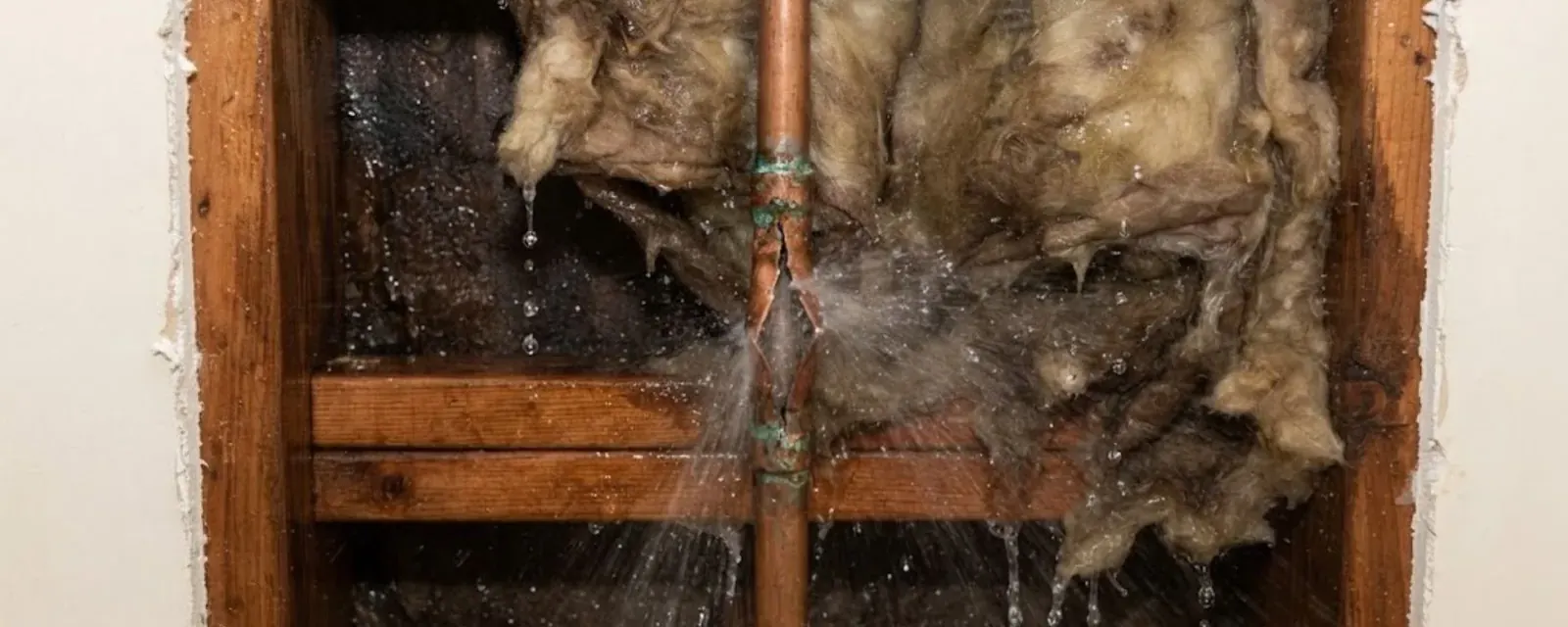
When a burst pipe is an emergency
A pipe that splits under pressure is always urgent. Household supply pressure often runs between 40 and 80 psi, and a split in a half-inch line can release a steady stream until someone closes a valve. Water follows framing, wiring and ductwork, so the wet area is usually larger than the visible puddle.
We take burst pipe calls at night, on weekends and on holidays, and same-day appointments are available when the schedule allows. While you wait, keep the main off, move belongings above the water line and stay away from wet ceilings that sag, since they can drop without warning.
What to do in the first ten minutes
Close the main
Find the main shutoff, usually where the water line enters the house, and turn it clockwise until it stops. A lever handle closes with a quarter turn.
Drain the lines
Open the lowest faucet in the house, then a high one. That relieves pressure and drains what is left in the pipes.
Cut power if it is safe
If water has reached outlets or a panel, switch off the breaker only when you can reach it over dry floor. Otherwise call and tell us.
Document it
Photograph the damage before you clean up. Your insurer will ask, and the photos also help us trace where the pipe failed.
Why pipes burst, and where we look first
Most bursts come from one of four causes: freezing, corrosion, a failed joint or fitting, and excess pressure. A hard Kansas freeze is the classic trigger. Pipes in an exterior wall, an unheated garage or a crawl space split where ice forms, though the leak often appears only after it thaws.
Corrosion works more slowly. Galvanized steel rusts from the inside and narrows before it pinholes, and older copper can wear thin at fittings. In those homes a burst is often a warning that the rest of the line is close behind, which is when repiping becomes worth discussing.
How the repair works
We locate the failed section, cut out the damaged length and replace it with new pipe and fittings sized to the original line. A short copper, PEX or CPVC section is often the same-day answer. If the pipe is buried in a slab or behind finished walls, we pinpoint it first with leak detection so we open only what we must.
After the repair we restore pressure slowly, check every joint we touched and look for a second weak point. We also check the pressure at a hose bib, because a house running near the upper end of the range stresses every fixture.
What a burst pipe repair costs: the factors
You get a clear price before work starts. The price moves with these:
- Which pipe failed, and how hard it is to reach.
- The material and diameter, plus how much of the line must be replaced.
- Whether walls, ceilings or a slab have to be opened and who restores them.
- Whether it is an after-hours emergency or a scheduled visit.
- Whether pressure or corrosion means more than one section needs work.
Homeowners insurance often covers sudden water damage from a burst pipe, while the cost of repairing the pipe itself and any long-term seepage may be excluded. Keep your photos, and ask your insurer before you start demolition. Want your real number? Call (855) 575-2890.
Safety steps when a pipe bursts
Water and electricity do not mix. If water reaches outlets, appliances or the panel, leave the area and shut off power at the main breaker only if you can do so safely and dry. Close the main water valve, open a low faucet to drain the line, and move valuables off the floor.
- Shut off the main water valve.
- Switch off power only if the area is dry.
- Photograph the damage for your insurer.
- Avoid standing water near outlets.
Codes that touch a pipe repair
Supply pipe repairs fall under the plumbing code your city has adopted, often based on the International Plumbing Code (IPC). Whether a repair needs a permit depends on its size, so ask the Leawood building department before a large repair.
Burst pipe questions from Leawood homeowners
Yes. The line is open 24/7, including holidays, for Leawood, KS and the nearby towns we serve. Tell us where the water is, what you shut off and the address. We book same-day appointments when the schedule allows and give a clear price before work starts.
Look where the water line enters the house, often in the basement, a utility room or near the water heater. The outdoor meter box has a utility valve too, but that one belongs to the water utility. If you cannot find or close the indoor valve, call and we will talk you through it.
Stop the water first, then call a plumber so the leak is fixed, then your insurer. Take photos of everything before cleanup. Many policies expect you to prevent further damage, and a repair invoice documents that you did.
Sometimes. Access panels, basement ceilings and crawl spaces often reach the pipe. When it is behind drywall, we use acoustic and thermal methods to find the exact spot first so the opening is small.
If the water appears in the yard, near the meter or in a basement wall where the line enters, the failure may be the water service line. WaterOne states that the customer-owned section is the customer's responsibility, and our water service line repair page explains that case.
Insulate pipes in exterior walls and unheated spaces, disconnect and drain outdoor hoses before the first hard freeze, and let a faucet drip on the coldest nights. If a pipe is frozen but not yet split, open the faucet and call us before using heat on it.