
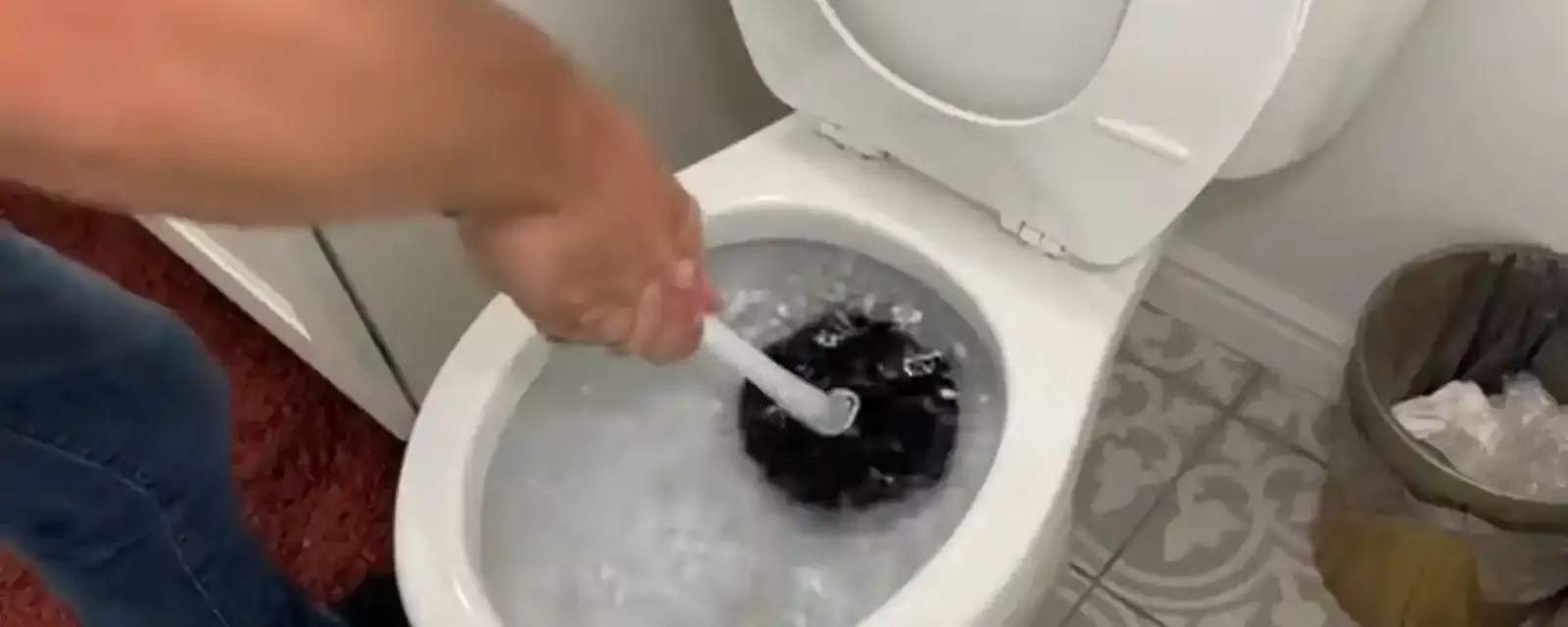
First, stop the water
Do not flush again. If the bowl is near the rim, lift the tank lid and press the flapper down to stop the refill, or close the shutoff valve behind the toilet by turning it clockwise. That prevents an overflow while you work. Put towels on the floor and open a window if the smell is strong.
If the water is clearly rising and will not stop, close the valve and wait for the level to drop before you try anything.
Use the right plunger
- A flange plunger, with a rubber flap that extends from the cup, seals in the toilet outlet.
- A flat cup plunger suits sinks and tubs, not toilets.
- Get the cup under water so it seals, and add water to the bowl if it is low.
- Push down gently first to expel air, then plunge with firm, steady strokes.
- Pull up sharply at the end of each stroke, since the suction pulls the clog loose.
- Repeat for a minute or so before judging whether it worked.
Many clogs clear in three to five cycles. If the water drains quickly, flush once to confirm.
When the plunger fails
A closet auger, also called a toilet snake, reaches farther. Feed the cable into the outlet, turn the handle and push until you feel resistance, then work through it. A closet auger has a vinyl sleeve that protects the porcelain. Standard drain snakes can scratch it.
Dish soap and hot, not boiling, water can help loosen soft clogs. Boiling water can crack porcelain, so avoid it. Chemical drain openers are not a good idea in a toilet, since they can sit in the bowl and splash.
Signs the clog is in the main line
A toilet clog is not the same as a sewer clog. If the toilet and the tub back up together, if the lowest drain in the house gurgles when you flush, or if several fixtures are slow, suspect the main line. Stop using water and see sewer line cleaning. A drain cleaning visit handles smaller blockages that do not need the main.
If the toilet clogs again and again, the cause may be a partial blockage deeper in the line, a vent problem or a low-flow toilet that does not flush hard enough. Persistent trouble deserves a camera inspection.
What not to flush
Paper breaks down and nothing else reliably does. Wipes labeled flushable do not behave like paper, and they mat together. Paper towels, feminine products, cotton swabs, dental floss and diapers all cause clogs. A small waste basket by the toilet is the simplest fix.
Why low-flow toilets clog more easily, and what helps
Modern toilets use less water, and a weak design can leave waste in the trap. If your toilet clogs often even with normal use, check whether the rim jets are clogged with mineral deposits, which weakens the flush. Cleaning the jets with a small mirror and a wire often restores flow, and vinegar soaked into the rim loosens scale.
Water level in the tank also matters. If it is set too low, the flush lacks power. Raise the fill level to the mark on the tank, and the flush often improves. Persistent weak flushing is a reason to inspect the flapper, the fill valve and the vent.
Safety and cleanliness
Toilet water carries bacteria, so wear gloves, avoid splashing and wash your hands and tools afterward. Open a window, put towels down and keep children and pets out of the room. Use a bleach-free disinfectant on the floor and the plunger, since bleach can react with other cleaners. After the job, run a flush or two to confirm the drain is clear.
Local note: how to tell an internal clog from a backup
Johnson County Wastewater says a backup in a drain that is not on the lowest level of your home is due to an internal clog, so the first move is to look at which floor is affected. If only an upstairs toilet is blocked, it is yours to clear. If the lowest drain and several fixtures back up together, call, and the utility runs a 24/7 line for suspected backups in the public main.
It also asks residents to keep household chemicals out of drains and to use Johnson County's Environmental Division for disposal. For addresses in Prairie Village and Overland Park, the same utility rules apply.
Questions about clogged toilets in Leawood
A partial blockage, a vent problem, a weak flush or too much paper. If it recurs, have the line looked at.
We recommend against it, since chemicals sit in the bowl and can damage seals and old pipe.
If it overflows or the whole house is backing up, yes. The 24/7 line is open.
It is sometimes needed for a stuck object. It requires a new wax ring and a flange check, so many people call a plumber.
If neighbors are affected, it may be the public main, otherwise it is probably your line.